

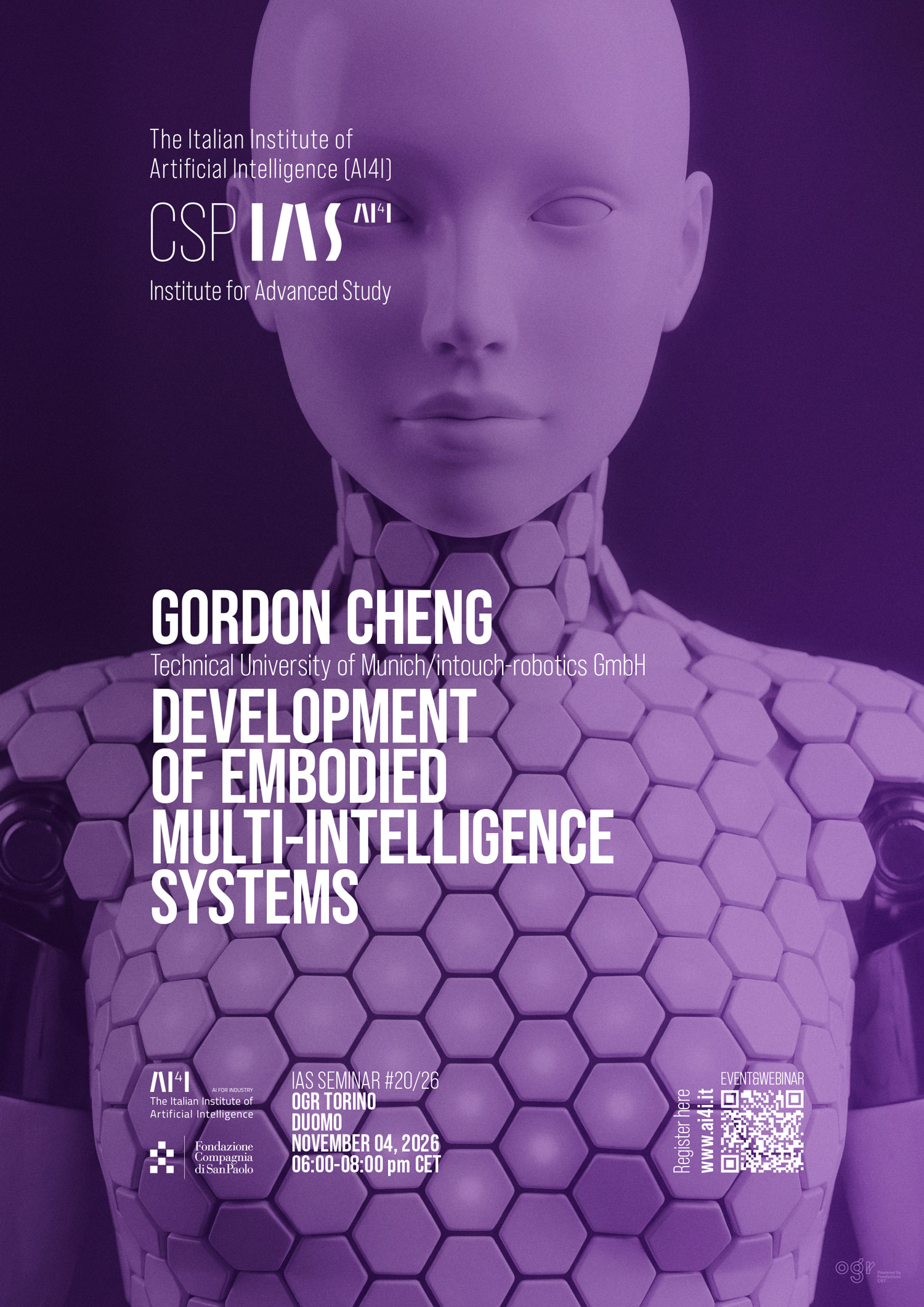
Prof. Dr. Gordon Cheng
Technical University of Munich/intouch-robotics GmbH
IAS SEMINAR #20/2026
Turin / OGR / Duomo / November 04, 2026 / 06:00 – 08:00 pm CET
Technical University of Munich/intouch-robotics GmbH
EVENT&WEBINAR
In this talk, I will discuss various aspects of embodied intelligence that I have been exploring over the years and present several case studies. These will range from morphological approaches to sensory-motor learning and cognitive reasoning. While many of these cases showcase successful examples of specialized forms of embodied intelligence, I want to raise an important question: Can we continue to engineer intelligent machines using our current methods, which compartmentalize intelligence into closed, singular forms? Or do we need a new methodology or a fundamental paradigm shift in how we think about embodied intelligence?
First, I will examine tactile intelligence in robots. Throughout our lives, we rely on our sense of touch, a versatile ability that provides awareness of the world and shapes our daily experiences. Significant advancements in whole-body tactile sensing for robots have led to the development of “tactile intelligence,” extending beyond the traditional capabilities of robotic systems. This advancement allows robots to sense their environment and physically interact with it in ways that resemble human behavior. I will share several examples of its applications, including whole-body interaction with humanoid robots, human-robot interaction, improved locomotion for humanoid robots, robot navigation among movable objects, locomotion control for bipedal exoskeletons, and robot collaboration.
Furthermore, there are still considerable challenges to overcome to fully realize intelligence in robotics. Thus, I will present aspects of robot learning from others. Learning from human demonstrations is one of the most powerful mechanisms for enhancing capabilities in both humans and robots. Here, I show three methods for human and robot learning from demonstrations: direct mimicry, goal selection, and purposive learning, which I believe will take Physical AI to new heights. I will illustrate aspects of these mechanisms through several real-world examples.
Prof. Dr. GORDON CHENG
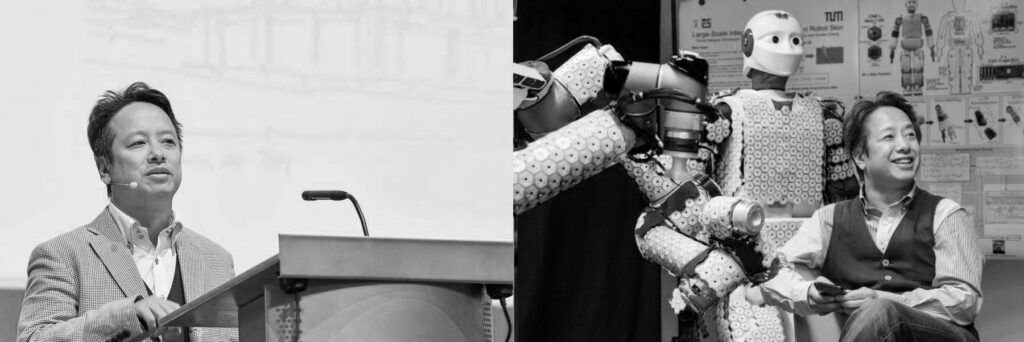
Professor Gordon Cheng is a pioneer in humanoid robotics, neuroengineering, and artificial intelligence, with over two decades of groundbreaking contributions to these fields. Since 2010, he has served as the Chair Professor for Cognitive Systems and is the Director of the Institute for Cognitive Systems at the Technical University of Munich, Germany. In addition to his academic roles, Cheng has founded three startups spanning logistics, high-performance actuators, and robotics. His latest venture, intouch-robotics, aims to apply his research on artificial sensitive skin to all robots across all industrial domains. In addition, he directs the prestigious Elite Master of Science in Neuroengineering (MSNE), a highly selective program within the Elite Network of Bavaria (ENB). Additionally, he oversees the Centre of Competence in Neuroengineering, underscoring his dedication to advancing research and education in these critical areas.
Gordon Cheng is an accomplished co-inventor of 20 patents and has co-authored over 450 technical publications, including conference proceedings, editorials, books, and book chapters. His groundbreaking interdisciplinary work earned him numerous prizes and awards, including the prestigious IEEE Fellowship in 2017, in recognition of his significant contributions to humanoid robotic systems and neurorobotics. In 2024, he was rightfully honored with the RSJ Fellowship for his outstanding achievements in robotics science and technology. Furthermore, he was awarded the esteemed European Research Council (ERC) Advanced Grant in 2023 to develop an innovative “soft exoskeleton suit designed to restore autonomous locomotion” (STROLL). His research interests are diverse and impactful, encompassing neuro-robotics, humanoid robotics, imitation learning, cognitive systems, artificial intelligence, and NeuroEngineering.
Joining us in person offers the opportunity for direct networking and interaction with both speakers and participants.
Please complete the form below to reserve your seat.
By clicking, you will be automatically registered for the in-person event.
Note: If you see a message saying you’re already subscribed, please ignore it — your in-person registration will still be confirmed.
Please note that, by attending, you implicitly authorize AI4I to film and photograph the audience during the seminar. By submitting your registration, you acknowledge and accept the AI4I Data Privacy Policy. Seats are limited: if you are unable to attend, we kindly ask you to inform us as soon as possible at ias@ai4i.it
LINK ZOOM
AI4I
The Italian Institute of Artificial Intelligence (AI4I)
Corso Castelfidardo 22, 10129 Torino
Codice fiscale 97904430010
Partita IVA: 13130030011

ai4i@ai4i.it
ai4i@pro-pec.it



Copyright © 2025 AI4I Foundation – Privacy & Cookies