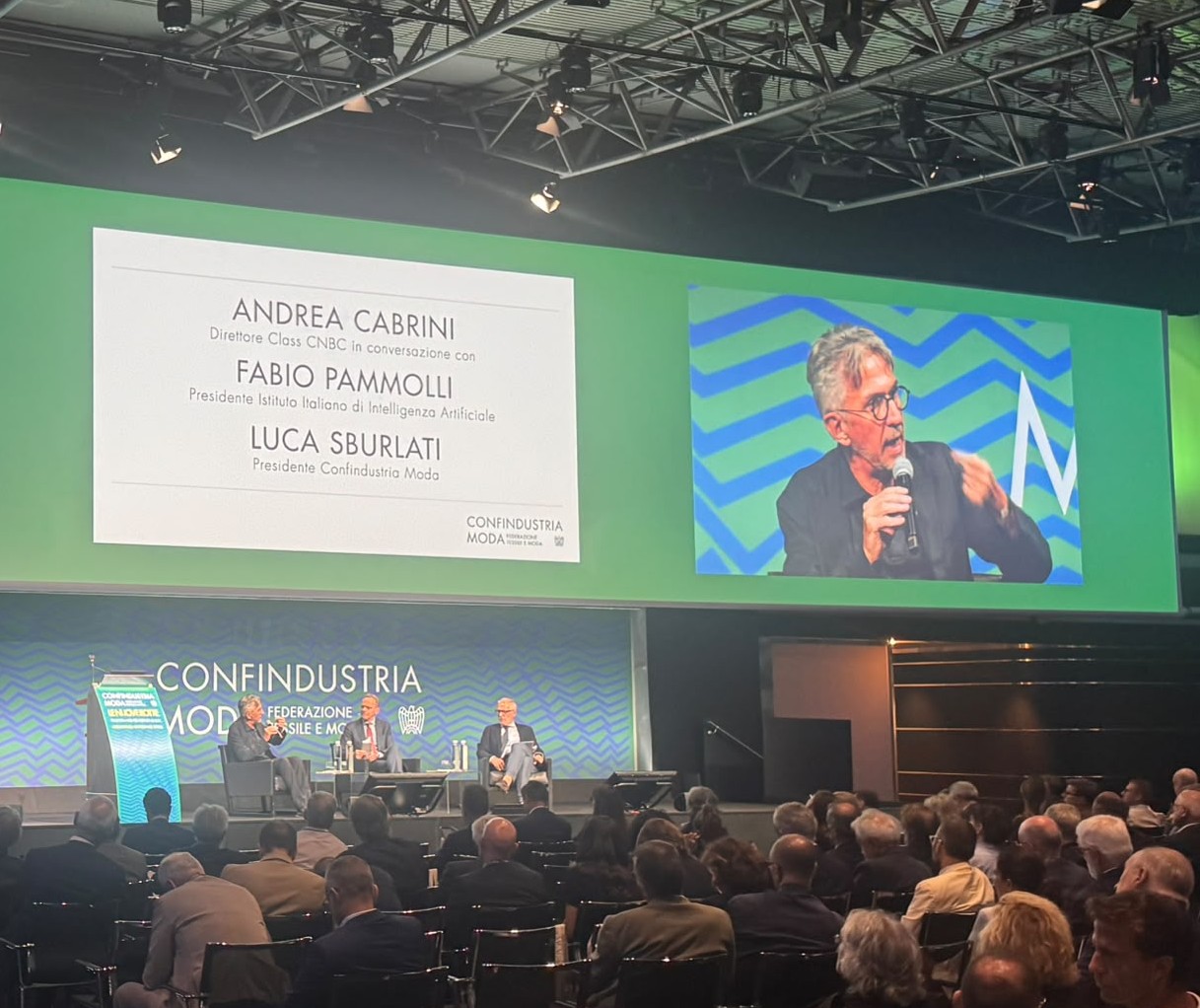
Presented during Confindustria Moda’s 2026 General Assembly, the programme has been developed together with Politecnico di Torino and Fondirigenti to support industrial transformation through applied AI, training and technology transfer.
During the 2026 General Assembly of Confindustria Moda, held on 30 June in Milan, titled New Routes – Transforming to Remain Leaders, Confindustria Moda and the Italian Institute of Artificial Intelligence (AI4I) presented a strategic initiative designed to accelerate the adoption of artificial intelligence across Italy’s textile, fashion and technical textiles supply chain.
Developed together with Politecnico di Torino and Fondirigenti, the programme represents one of the strategic initiatives presented during the General Assembly and aims to help companies integrate artificial intelligence into industrial processes through experimentation, executive and technical training, and the development of scalable industrial use cases.
A strategy for transforming the supply chain
The initiative addresses one of the main challenges facing the Italian fashion industry: enabling widespread AI adoption across a manufacturing ecosystem largely composed of small and medium-sized enterprises.
To achieve this objective, AI4I, Confindustria Moda, Politecnico di Torino, Piemonte Innova and Fondirigenti have designed a structured programme combining applied research, engineering expertise, technology transfer and workforce development to create practical, scalable and replicable solutions for the entire value chain.
“For companies across Italy’s Fashion System, it is strategic to integrate new tools, new analytical capabilities and new skills into business processes and corporate assets. The agreement between the Italian Institute of Artificial Intelligence (AI4I) and Confindustria Moda was created to accompany and accelerate this journey: experimenting, training and transferring innovation so that AI becomes a distinctive capability across the entire supply chain,” said Fabio Pammolli, President of the Italian Institute of Artificial Intelligence (AI4I).
From an industrial pilot to scalable solutions
The project starts from the Ferraris case, a textile finishing company based in Biella, selected as the first industrial pilot because of the representativeness and complexity of its production processes.
Building on this real-world environment, the partners will develop two complementary categories of AI applications: short-term use cases capable of delivering immediate operational benefits and longer-term projects based on industrial sensing, data collection and advanced artificial intelligence models.
“The initiative aims to build a shared AI adoption model for the entire textile, fashion and technical textiles supply chain through the development of concrete use cases, experimentation in pilot companies and a broad executive and technical training programme. It is a project designed to accelerate technology transfer towards companies, increasing competitiveness, productivity and the innovation capacity of the entire fashion system, which is made up primarily of small and medium-sized enterprises that have innovation in their DNA, although they cannot always undertake the investments required by new technologies,” said Luca Sburlati, President of Confindustria Moda.
A three-phase roadmap
The programme follows a three-stage roadmap.
- The first phase focuses on project design, governance, participating companies, KPIs and the operational model.
- The second phase includes AI maturity assessments, workforce training and the development of the first industrial use cases.
- The third phase will scale validated solutions across the broader supply chain, transforming successful pilots into replicable industrial models.
Throughout the programme, AI4I’s AI Foundry will provide a dedicated “before invest” testing environment, allowing companies to validate AI solutions before large-scale implementation.
The first project results are expected by November 2026, while supply-chain scaling activities will continue throughout 2027.