
What changes when artificial intelligence moves from being a tool to becoming a core driver of scientific discovery? And how far are we from a world where materials are no longer discovered—but designed?
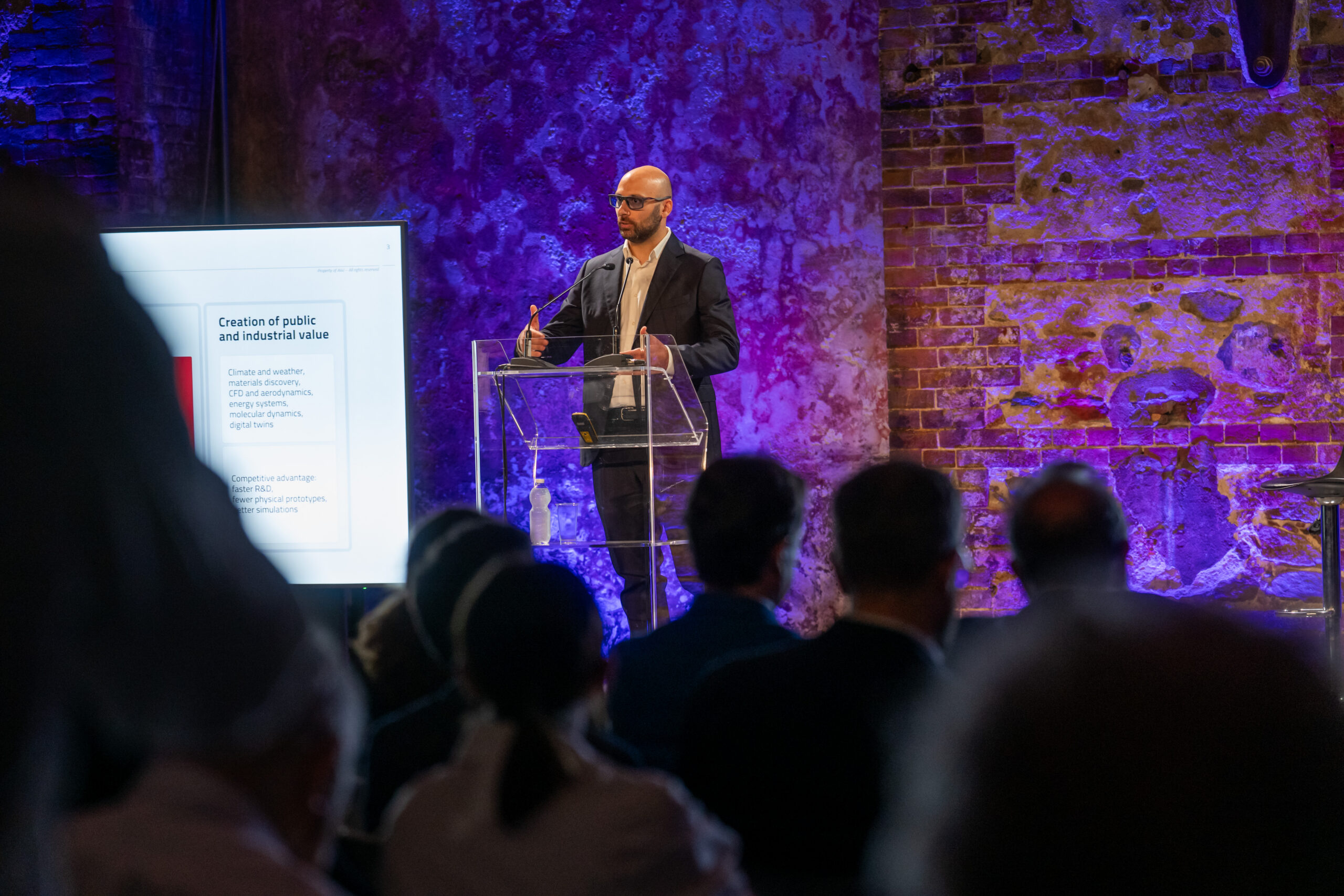
These questions were at the heart of the lecture delivered by Nobel Prize laureate in Physics Konstantin Novoselov on March 17 at OGR Torino, opening the 2026 programme of the IAS – Institute for Advanced Study, the joint initiative of the Istituto Italiano di Intelligenza Artificiale (AI4I) and Fondazione Compagnia di San Paolo. The event brought together researchers, industry representatives and a broader public for a reflection that sits at the intersection of physics, materials science and artificial intelligence. Building on the themes also explored in his recent interview with La Stampa, Novoselov outlined a profound shift in how science itself is conducted.
At the core of his argument is a transition already underway: from serendipitous discovery to intentional design. Artificial intelligence is not simply accelerating existing processes; it is enabling scientists to model, simulate and engineer materials with an unprecedented level of precision. This opens the possibility of working directly at the atomic scale, shaping properties and behaviours that were previously beyond reach.
Among the most striking implications is the development of adaptive and self-healing materials—systems capable of responding dynamically to external conditions and repairing themselves without external intervention. Such advances have far-reaching consequences across multiple sectors, from energy and infrastructure to manufacturing and advanced electronics.
Novoselov also addressed a broader epistemological question: what is the evolving role of the scientist in this new landscape? Rather than replacing human intelligence, AI reshapes it—augmenting our capacity to explore complexity while requiring new forms of understanding and interpretation.
In this sense, the transformation is not only technological, but cognitive. The integration of AI into scientific workflows is redefining the boundary between science and engineering, and more fundamentally, between discovery and design.
The IAS – Institute for Advanced Study was conceived precisely to host this kind of dialogue: a platform where global scientific excellence, industrial innovation and interdisciplinary reflection converge. The lecture by Novoselov marks a significant step in this direction, setting the tone for a programme that aims to explore the most advanced frontiers of artificial intelligence and its impact on society.
As Novoselov concluded, the ultimate challenge remains deeply human: understanding life and ourselves. Technology may accelerate the path—but it does not replace the questions.