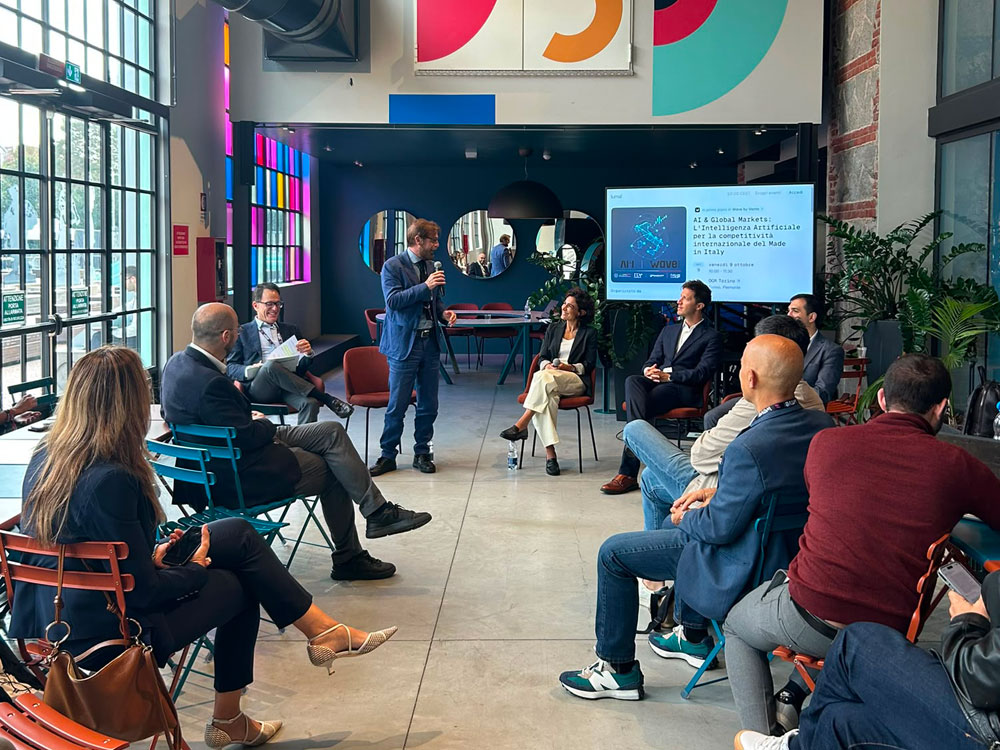

Riccardo Di Maria contributed to the discussion on artificial intelligence and economic transformation, bringing AI4I’s perspective on advanced computing infrastructure, research and industrial adoption.
On 8 October 2026, AI4I took part in “AI and the Economy”, a session of the conference “What Will Happen to Us with AI?”, hosted by the Academy of Sciences of Turin. The event brought together researchers, academics and experts to examine the economic, technological and societal implications of artificial intelligence.
Riccardo Di Maria, Head of HPC/AI and Engineering at AI4I and Lab Director of HPC Architecture & Method, contributed to the session with a talk entitled “AI as a New Industrial Infrastructure”, bringing the Institute’s perspective to the debate on the relationship between technological innovation, industrial transformation and economic value creation.
The contribution addressed the role of advanced computing infrastructure and technological capabilities in supporting the adoption of artificial intelligence across industrial sectors. Within this framework, AI4I’s approach places particular emphasis on connecting scientific research, engineering expertise and the needs of businesses, creating the conditions for companies to integrate AI solutions into production processes and organisational activities.
Shared technological capabilities and technology transfer are central to this model. Through its research laboratories, engineering expertise and advanced computing infrastructure, including the AI Foundry Peano, AI4I works to support the development, testing and industrial application of artificial intelligence, with particular attention to the needs of Italian companies and SMEs.
The session, chaired by Marco Mezzalama of the Academy of Sciences of Turin, featured contributions from Pietro Terna, Emilio Paolucci, Giovanni Durbiano and Giuseppe Russo, addressing the implications of artificial intelligence for employment, organisational structures, cities and financial markets.
The discussion provided an opportunity to examine how AI is reshaping economic systems and the capabilities required to translate technological progress into productivity gains, innovation and industrial competitiveness.